Security Guard Roles and Responsibilities: A UK Guide to Modern Manned Guarding
- Khanum Shaan
- Apr 26
- 15 min read
Security guard roles and responsibilities in the UK fall into 5 working areas: controlling site access, running structured patrols, responding to incidents inside the first 60 seconds, calming confrontations without physical force, and writing documentation insurers will accept. That is the job.
The old picture of a uniformed figure sat at a reception desk waiting for trouble bears little resemblance to what a licensed officer does on a UK site. Anyone still hiring on that outdated model is paying for presence and getting almost no protection.
Manned guarding in the UK is a regulated profession. The Security Industry Authority (SIA), set up under the Private Security Industry Act 2001, sets minimum competencies for every frontline operative. Licensing is the floor, not the ceiling. A good officer reads risk, handles people well, records everything, and reduces the frequency of bad events before they cost anyone money.
This guide breaks down the duties and responsibilities a UK security guard actually carries on site, what legal requirements apply, how the job changes between sectors, and what businesses should look for when hiring.
The 5 core roles and responsibilities of a professional security guard
The 5 primary roles and responsibilities of a UK security guard are access control, patrolling and surveillance, incident response, conflict de-escalation, and reporting. Each one involves distinct training and judgement. Treating them as a tick-box list misses the point. They work together, and an officer weak in any single area creates exposure across the other four.
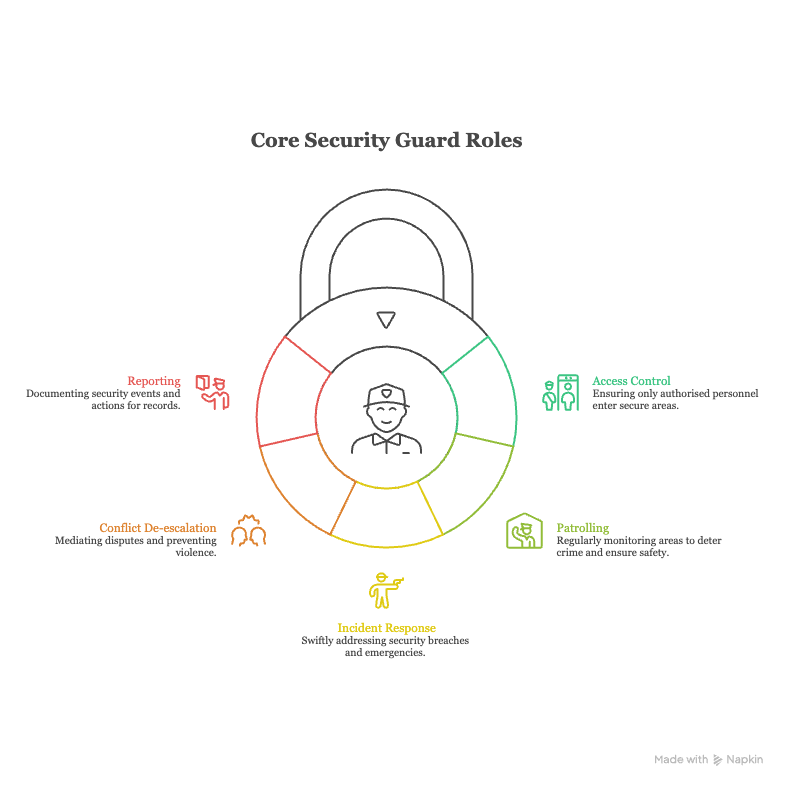
1. Access control and visitor management
Access control is the first layer of defence on any site. In practice that means verifying credentials against visitor management systems, logging arrivals and departures, challenging anyone without a valid reason to be on site, and managing the flow of people during shift changes or peak hours.
On a retail park or a hospital campus, access control alone can prevent tens of thousands of pounds in annual losses. On a construction site with expensive plants stored overnight, it stops the theft before the theft becomes a possibility. The visible challenge at the gate is the product.
2. Patrolling and surveillance
Patrolling involves more than walking. Walking, any competent adult can do. Patrolling well means reading a space: the fire door propped open with a wedge, the unfamiliar van parked off the marked bays, the person whose posture and pace do not fit the setting.
Structured patrols vary on purpose. Predictable routes are a gift to anyone planning theft or trespass. A good officer changes timing, changes route order, and pairs foot patrol with CCTV checks. The goal is to make the site feel actively watched, not occasionally checked.
3. Incident detection and first-minute response
The first 60 seconds of any incident decide a lot. A trained officer reads a developing situation, picks the right action, and either contains it or brings in emergency services without losing control of the scene. That early decision window matters for everything that follows, including the legal case if one develops later.
A medical collapse, a theft caught mid-act, and an argument escalating at the front desk all demand different responses. The skill is knowing which is which, fast.
4. Conflict de-escalation
Communication is the officer's primary tool. Well before physical intervention enters the picture, a skilled officer uses tone, body language, space management, and plain spoken dialogue to reduce the temperature of a situation.
Physical force is a last resort, and for good reason. It is dangerous to the officer. It is dangerous to the other party. It creates legal risk for the client. And it rarely solves the underlying problem. An officer who has talked twenty people out of a bad evening is worth more than one who has restrained five.
5. Reporting and documentation
Every incident, no matter how small, needs a written record. Accurate, timestamped documentation builds the paper trail insurers, solicitors, and police rely on later. A scuffle that went no further, a refused entry, a suspicious item in a car park. All of it goes in the log.
The log is boring and it is the thing that saves clients money when something goes wrong six months later. Poor documentation is the single most common reason security incidents become expensive.
SIA licensing: the legal foundation you cannot skip
Before hiring any officer, a UK business has one question to settle first: is this person legally allowed to do security work? Deploying an unlicensed guard is a criminal offence under the Private Security Industry Act 2001. Not a technicality. An actual offence with real consequences.
What the SIA licence covers
The SIA regulates private security in the UK and issues licences across several categories. The common frontline licences for manned guarding are the Security Officer licence and the Door Supervisor licence. Vehicle immobilisation and CCTV operator licences cover their own specialisms.
To get a licence, a candidate completes approved training, passes assessed exams, clears a criminal record check, and proves their identity and right to work in the UK. Training covers 4 working areas in particular:
Legal powers and limitations, including what an officer can and cannot lawfully do
Conflict management, including de-escalation and communication under pressure
Physical intervention, where the licence calls for it, covering proportionate restraint
Emergency response, including first aid, fire procedures, and evacuation protocols
The cost of cutting corners
Cheaper firms using unlicensed staff are a false saving. The risks fall directly on the client. Businesses caught using unlicensed operatives face potential prosecution, unlimited fines, and loss of Approved Contractor Scheme (ACS) status if they hold it. The reputational damage often outlasts the financial hit.
There is also the direct security risk. Unlicensed staff have not been vetted. They have not been trained to the SIA standard. They may not understand the legal limits of their role, which means the client carries liability for any bad decision they make on site.
A reliable operation sits on a licensed foundation. Anything else is borrowed time.
Sector-specific duties and responsibilities: one role, many environments
The 5 primary duties apply everywhere. The way these roles and responsibilities get applied changes sharply by sector. A retail officer and a construction officer share the same licence, but almost nothing else about their working day looks the same. The sections below cover the main UK environments where SIA-licensed security guards are deployed, with the distinctive duties each one calls for.
Retail security
Loss prevention sits at the heart of retail security. Officers monitor customer behaviour, watch high-theft zones, manage stockroom access, and work with store management to spot repeat offenders and emerging theft patterns.
Retail has a specific metric called prevented loss, which is the estimated value of stock that would have walked out without a security presence. Loss prevention managers use it to justify the security budget upward to the board. Retail officers are also often the first public-facing staff a customer speaks to, so interpersonal skill carries real weight.
Hotel security
Hotel security balances guest experience with asset protection. Officers manage access to guest floors, watch for non-residents loitering in lobbies, handle noise complaints between rooms, escort intoxicated guests off premises without the situation escalating, and support the night manager at the front desk during unsocial hours. A hotel security officer who can de-escalate a 2am room dispute without the police getting involved is worth more than the monthly fee on the contract.
Warehouse security, logistics and distribution
Warehouse security and logistics and distribution sites share a risk profile: high volumes of stock moving through a fixed location, with drivers, contractors, and pickers all moving at pace. Officers focus on vehicle gate control, delivery verification, seal checks on trailers, and internal access to high-value stock zones. Stock theft from UK distribution hubs runs into the hundreds of millions annually. A strong gate presence is the single biggest deterrent.
Factory security and pharmaceutical sector sites
Factory security and security for the pharmaceutical sector share a compliance-heavy working environment. Factory officers cover perimeter patrols, contractor access, vehicle inspections, and alarm response during quiet hours. Pharmaceutical sector sites add regulatory layers: controlled substance handling, CCTV evidence integrity, and chain-of-custody records for site access during MHRA audits. Either environment calls for officers who can write clean reports because the paperwork feeds directly into compliance reviews.
Construction security
Construction security protects high-value targets: plant machinery, copper cabling, fuel, tools, and building materials. Officers focus on perimeter control, vehicle access, overnight asset protection, and supporting health and safety compliance during working hours by challenging unauthorised access. A single incident of plant theft can run to six figures, so the investment in overnight cover pays back quickly.
Corporate and front-of-house
Corporate security blends into the visitor experience. Officers working reception in a commercial building verify visitor credentials, maintain access logs, handle deliveries, run the fire alarm procedure if needed, and respond to incidents while projecting the brand image of the tenant.
The best corporate security officers read the room. They know when to be warm, when to be formal, and when to shift registers fast. That balance is harder to train than the technical parts of the job.
Door supervision for pubs and clubs
Door supervision and pubs and clubs security are the most public-facing end of manned guarding. Officers hold the SIA Door Supervisor licence rather than the standard Security Officer licence, because the role involves regulated handling of intoxicated customers, refusing entry on legitimate grounds, searching for prohibited items, and supporting licensees with the four licensing objectives. A door supervisor is on the front line of the Licensing Act 2003 every Friday and Saturday night, and a well-trained doorkeeper prevents more trouble than any CCTV camera ever has.
Event security: corporate, sporting, festival, and wedding deployments
Event security covers a broad spread of formats, and the risk profile shifts sharply with each one.
Corporate event security focuses on guest list control, VIP protection, AV equipment cover during conferences, and managing journalists or protestors at product launches. Sporting event security handles ticketed crowds, pitch invasion prevention, alcohol policy enforcement under the Sporting Events (Control of Alcohol etc.) Act 1985, and stadium evacuation protocols. Festivals and concert security scales the crowd management challenge to tens of thousands across multi-day events, with entry searches, crowd pressure monitoring at stage fronts, lost property handling, and welfare support for attendees. Wedding security is smaller in scale but sensitive in execution, covering guest list enforcement, vendor coordination, and the occasional delicate job of managing an unwanted ex-partner trying to gatecrash without creating a scene in front of the couple.
Across all of these, officers run to the '4 P's' framework used across the UK events industry: Planning, Prevention, Protection, and Preparation. A bad event deployment is obvious to everyone who attended. A good one is mostly invisible, which is the point.
Education security and student accommodation
Education security and student accommodation protection both prioritise safeguarding. Officers on school and university sites handle visitor sign-in, perimeter patrols, lockdown drill support, and lone-worker escorts for staff working late. Student accommodation security adds out-of-hours concerns: noise management, access control against non-residents, welfare checks on students in crisis, and coordination with university welfare teams. Both environments demand officers who can speak plainly to young people without being either heavy-handed or dismissive.
Entertainment and art security
Entertainment and art security covers galleries, museums, auction houses, theatres, and film sets. The assets are frequently irreplaceable, with insured values running into seven or eight figures for a single item. Officers manage public access during open hours, overnight alarm response, artwork movement procedures, and VIP access during private views and openings. Discretion is part of the brief. A poorly trained officer at a gallery private view damages the client relationship before the wine is poured.
Vacant property security
Vacant property security protects buildings between occupants. Empty commercial units, closed schools awaiting redevelopment, and vacant retail stores attract squatters, metal thieves, and arsonists. Officers deploy through a mix of manned guarding, mobile patrols, and CCTV monitoring, often paired with physical security products like steel screens and alarms. An unattended vacant building is a liability waiting to become an insurance claim.
Gatehouse security
Gatehouse security is the specialism behind the site entrance. Officers verify every vehicle and person entering an industrial estate, corporate park, or logistics hub, log visitor numbers, issue passes, and coordinate with site managers on unexpected arrivals. A well-run gatehouse is the first filter on every downstream site risk, and a lazy gatehouse is a liability for every tenant inside the fence line.
Key holding and alarm response
Key holding and alarm response covers what happens when a business alarm triggers outside working hours. A keyholder company stores keys and codes securely, responds to alarm activations within a contracted response time, attends site, assesses the cause, resets the alarm where appropriate, and escalates to the police if a break-in is confirmed. Using an external key holding service means staff are never called out at 03:00 to deal with a false alarm, which reduces insurance costs and HR risk in one move.
Writing a security guard job description that actually filters candidates
A job description is not a formality. It is the first filter between the client and the wrong hire. Most bad security hires trace back to a vague job description that failed to screen properly, or one that listed duties and responsibilities without any thought for the skills that deliver them.
Essential qualifications
Non-negotiable items include a valid SIA licence in the relevant category, a confirmed right to work in the UK, and a minimum 5-year checkable history covering employment, education, and unexplained gaps. BS7858 vetting is the standard reference point for this check.
Skills that predict performance
Qualifications confirm eligibility. Skills predict how the officer performs on shift. The 3 skills that carry the most weight are:
Verbal communication, for de-escalating situations and dealing with the public.
Situational awareness, for spotting anomalies before they become incidents.
First aid competency, for responding to medical events until paramedics arrive.

A candidate strong in all three will prevent more incidents in a quiet year than a stronger-built candidate without them.
Daily task list
A typical shift involves more than standing by a door. Realistic duties include shift handovers with outgoing personnel, perimeter patrols at scheduled intervals, CCTV monitoring, access control, incident log maintenance, and welfare checks where a site has lone workers or vulnerable visitors.
Physical demands
The physical side of the job is often underestimated by candidates and clients both. Guards routinely spend 8 to 12 hours on their feet. On larger sites they cover several kilometres in a shift. And they have to stay composed under pressure when dealing with difficult members of the public. Stamina and emotional regulation are not optional extras. They are the jobs.
Advanced skills that separate a good officer from an exceptional one
The job description captures duties on paper. What actually separates an exceptional officer from a functional one sits outside the description.
Situational awareness
Situational awareness is the single most valuable skill an officer can develop. It is the ability to read an environment continuously, register small changes, and flag them before they turn into incidents. Unusual behaviour, a crowd starting to compress in one spot, an unattended bag in a busy foyer, a car parked off pattern. None of these are incidents by themselves. All of them are data.
Officers who are good at this are calmer on shift, make fewer mistakes in a crisis, and prevent more events than they respond to. The skill is trained through experience and deliberate practice.
Emergency first aid
Security officers are often the first responders on scene during a medical event. Cardiac arrests, falls, seizures, and injuries from altercations all benefit from a trained first aider in the critical minutes before paramedics arrive. UK clients increasingly ask for officers with Emergency First Aid at Work (EFAW) or First Aid at Work (FAW) certification as part of the contract.
Public-facing conduct
An officer's manner is the visitor's first impression of the client's business. How they greet people, handle tense moments, and communicate in writing and in person reflects on the client's brand. A rude officer can damage a reputation faster than a good marketing campaign can build one. A professional officer quietly adds to the visitor's trust in the building or business.
The ROI of professional manned guarding
Manned guarding in the UK is a measurable investment, not a line item to tolerate. The return shows up in 3 areas: direct losses avoided, insurance costs, and staff retention.
Shrinkage and theft reduction
Retail businesses, warehouses, and logistics hubs consistently report lower stock loss when professional officers are deployed. Visible, trained presence deters opportunistic theft before it happens. The effect compounds over time as known offenders stop attempting the site.
Insurance premiums
Many UK insurers reduce premiums for businesses that can demonstrate strong physical security. Documented patrols, incident logs, and access control records signal lower liability exposure to underwriters. The cost of security is partly offset every renewal cycle.
Employee wellbeing and retention
In high-risk environments like hospitals, late-night retail, and transport hubs, staff who feel protected perform better and stay longer. Turnover is expensive. A security investment that quietly reduces staff anxiety pays back through retention even when no incident occurs.
A professional security operation does not just prevent losses. It creates the conditions for a business to run with confidence.
Common mistakes UK businesses make when hiring security
A few patterns show up again and again when businesses hire badly for security. Most of them are avoidable, and most of them come back to misunderstanding the duties and responsibilities a modern officer is expected to deliver.
The first mistake is choosing on price alone. A contract that undercuts the market by 20% is usually funded by paying officers below market rate, which produces a workforce that does not stay, cannot be vetted properly, and turns over so fast no officer learns the site. The apparent saving disappears within two incidents.
The second mistake is not checking SIA licences directly. Licences can be verified on the SIA public register. Firms occasionally deploy officers whose licences have lapsed or been revoked. The client carries the liability, not the firm.
The third mistake is treating security as a separate function instead of a business partner. Officers who never speak to the site manager, who get no brief on the business, and who are left to work out the priorities on their own will miss things that matter. A short weekly meeting between the site contact and the contract manager is worth more than an extra patrol hour.
The fourth mistake is not reviewing the contract annually. Sites change. Risks change. A security contract written three years ago for a growing site is almost always wrong by now.
Frequently asked questions about UK security guard duties
What is the difference between a security guard and a door supervisor?
A security guard holds an SIA Security Officer licence and works static, patrol, or mobile roles on sites like offices, construction, retail, and industrial premises. A door supervisor holds an SIA Door Supervisor licence and works in licensed premises such as bars, clubs, and events, where the role includes additional training in physical intervention and handling intoxicated customers.
How much does manned guarding cost in the UK?
Hourly rates for SIA-licensed manned guarding in the UK sit across a wide range depending on location, site risk, and shift pattern. London and the South East typically sit at the higher end. Night shifts, weekend cover, and lone-working sites attract premiums. Reputable ACS-approved firms are transparent about their pricing model and what is included in the rate.
How do I check if a security guard's SIA licence is valid?
The SIA maintains a public register on its official website where anyone can check the status of a licence by entering the licence number or the officer's name. Checking directly takes under a minute and confirms the licence is current.
Can a security guard detain someone?
An SIA-licensed officer has the same powers of citizen's arrest as any member of the public, under Section 24A of the Police and Criminal Evidence Act 1984. That power applies to indictable offences and requires it is not reasonably practicable for a constable to make the arrest. Officers are trained on the legal limits of this power as part of licensing.
What hours do security guards typically work?
Security shifts in the UK commonly run 12 hours, with 07:00 to 19:00 day shifts and 19:00 to 07:00 night shifts as standard patterns. Retail and corporate roles more often follow 8-hour shifts matching opening hours. Event and mobile patrol work is usually scheduled around site-specific needs.
Is CCTV monitoring included in a standard security guard role?
On-site CCTV monitoring by a guard on a shift does not require a separate licence. Remote CCTV monitoring from a dedicated control room (known as public space surveillance) does require a CCTV Operator licence. If a contract includes off-site monitoring, the client should confirm the licence category before the contract starts.
What types of security services do UK businesses typically need?
UK businesses use different security services depending on site and risk profile. Common deployments include retail security for shops and shopping centres, construction security for active sites with expensive plant, hotel security for guest-facing venues, warehouse security and logistics and distribution cover for stock-heavy sites, door supervision for pubs and clubs security, event security across corporate event security, festivals and concert security, sporting event security, and wedding security, education security for schools and universities, student accommodation cover for halls of residence, pharmaceutical sector security for compliance-heavy sites, factory security for production lines, entertainment and art security for galleries and theatres, vacant property security for empty buildings, gatehouse security for controlled access points, and key holding and alarm response for out-of-hours cover. Most SIA-licensed providers offer several of these as named service lines, which makes it easier for a buyer to match the right contract to the right site.
Can one security firm cover multiple sites across the UK?
Yes, and most UK businesses with more than one location benefit from a single provider running the national contract. Using one firm across sites gives the client consistent reporting formats, a single account manager, pooled officer resources during sickness or short-notice cover, and one invoice per month. A firm with an ACS-approved operating model and national coverage can run a retail portfolio, a logistics network, or a multi-site education contract under one set of standards.
Key takeaways
Security guard roles and responsibilities in the UK sit inside a regulated, skills-based profession, and treating the job as anything less is a hiring mistake. The points below are the ones worth carrying forward.
The role has moved past passive deterrence. Today's officers run access control, structured patrols, incident response, de-escalation, and documentation as primary professional functions.
SIA licensing is a legal requirement, not a preference. Deploying unlicensed staff exposes the client to criminal liability, unlimited fines, and direct security risk.
Duties vary by sector. Retail, corporate, construction, and event work each demand tailored approaches, and effective deployment reflects that difference.
A sharp job description is the first filter. Verifying SIA credentials, running BS7858 vetting, and prioritising communication and situational awareness will outperform hiring on availability alone.
The ROI is measurable. Prevented loss, reduced claims, lower insurance premiums, and better staff retention are quantifiable outcomes.
Price alone is the wrong benchmark. Cheap security is cheap for a reason, and the reasons almost always show up on the client's books eventually.
Alpha Security Services operates as a UK-wide, SIA-licensed provider covering retail security, construction security, hotel security, warehouse security, logistics and distribution cover, factory security, pharmaceutical sector sites, corporate event security, festivals and concert security, sporting event security, wedding security, door supervision, pubs and clubs security, education security, student accommodation cover, entertainment and art security, vacant property security, gatehouse security, and key holding and alarm response. A site-specific security review costs considerably less than fixing the wrong contract after an incident.
Supporting data
Employing unlicensed staff can lead to heavy fines, prosecution, and the loss of Approved Contractor Scheme (ACS) status. Source: Security Industry Authority (SIA) and GOV.UK.
SIA-licensed security professionals in the retail sector are estimated to prevent between £476.5 million and £953 million in theft annually. Source: British Retail Consortium.
Standard security officer roles in the UK typically require a 5-year checkable work or education history for BS7858 vetting. Source: National Careers Service.
The Health and Safety Executive (HSE) notes that a professional security presence helps manage risks in high-traffic sectors like retail and hospitality. Source: HSE.
Security presence reduces violence and property damage, saving businesses an estimated £200 million to £400 million in direct costs. Source: British Retail Consortium.


Comments